Srisailam is one of the most important pilgrimage and forest regions of Andhra Pradesh, but it is not a separate administrative district in the present-day state. Srisailam is a town and mandal in Nandyal district, located in the Nallamala Hills along the Krishna River. The area is famous for the Sri Bhramaramba Mallikarjuna Swamy Temple, Srisailam Dam, forests and wildlife.
Srisailam has a unique combination of religious, historical and natural importance. The Mallikarjuna shrine is one of the 12 Jyotirlingas, while the Bhramaramba shrine is traditionally revered as a Shakti Peetha. The surrounding Nallamala forests and the Nagarjunasagar-Srisailam landscape further make the region an important destination for nature and pilgrimage tourism.
Quick Information About Srisailam
| Particular | Details |
| Name | Srisailam |
| State | Andhra Pradesh |
| Present District | Nandyal |
| Administrative Status | Town and Mandal |
| Mandal | Srisailam |
| Revenue Division | Atmakur |
| PIN Code | 518101 |
| Main Language | Telugu |
| Other Languages | Hindi, Urdu and local tribal languages |
| Major River | Krishna |
| Geographical Region | Nallamala Hills |
| Famous For | Mallikarjuna Jyotirlinga, Bhramaramba Temple, Srisailam Dam and forests |
| Important Places | Srisailam Temple, Pathala Ganga, Srisailam Dam, Akka Mahadevi Caves and Shikaresvara Temple |
Srisailam should therefore not be described as a separate district in the current administrative structure. It is a major pilgrimage town within Nandyal district, Andhra Pradesh.
Important PIN Codes in Srisailam Region
The Srisailam town and surrounding mandal are served by postal facilities connected with the local settlements.
| Area | PIN Code |
| Srisailam | 518101 |
| Sunnipenta | 518122 |
| Dornala | 518176 |
| Atmakur | 518422 |
| Markapur | 523316 |
| Doranala region | 518176 |
| Velugodu | 518533 |
| Nandikotkur | 518401 |
PIN codes can vary according to the exact post office and locality. The precise post office should be confirmed before using a PIN code for official postal purposes.
Important Facts About Srisailam
Here are some useful facts that make Srisailam distinctive:
- Srisailam is a town and mandal in Nandyal district, not a separate district.
- It is located in the Nallamala Hills of Andhra Pradesh.
- The town is situated near the Krishna River.
- Srisailam is one of India’s major Shaiva pilgrimage centres.
- The Mallikarjuna Swamy Temple is one of the 12 Jyotirlingas.
- The Bhramaramba Devi Temple is traditionally regarded as a Shakti Peetha.
- The Srisailam temple complex is managed by Sri Bhramaramba Mallikarjuna Swamy Varla Devasthanam.
- Srisailam Dam is built across the Krishna River.
- The surrounding forests form part of the Nagarjunasagar-Srisailam Tiger Reserve landscape.
- Pathala Ganga is an important pilgrimage and sightseeing location.
- Akka Mahadevi Caves are among the best-known natural attractions in the region.
- Shikaresvara Temple is another important religious destination near Srisailam.
- The region has strong connections with the Chenchu tribal community.
- Maha Shivaratri is one of the most important religious occasions at Srisailam.
- The Nallamala landscape gives Srisailam considerable potential for nature and eco-tourism.
Location and Geography of Srisailam
Srisailam is located in the Nallamala Hills of the Eastern Ghats in southern Andhra Pradesh. The town lies close to the Krishna River and is surrounded by extensive forested terrain.
The area is connected geographically with:
- Nandyal district towards the north and west
- Nagarkurnool district, Telangana towards the north
- Prakasam and Markapuram regions towards the east and south-east
- Kurnool region towards the west
Important geographical features include:
- Nallamala Hills
- Krishna River
- Srisailam reservoir
- Dense forest areas
- Rocky hill formations
- Valleys and gorges
- Waterfalls
- Wildlife habitats
- Natural caves
The combination of hills, forests and the Krishna River gives Srisailam a distinctive landscape that supports both pilgrimage and nature tourism.
History of Srisailam
Ancient History
Srisailam has a very old religious history. The sacred hill has been mentioned in traditional Hindu literature and has been associated with Shaivism for many centuries.
Historical and inscriptional evidence also indicates the importance of Sriparvata/Srisaila as a religious centre in the Deccan. The region’s religious history developed alongside Buddhist and Hindu traditions in the wider Krishna River valley.
Temple History
The Sri Bhramaramba Mallikarjuna Temple has received patronage from several ruling dynasties over the centuries. Historical traditions and inscriptions associate Srisailam with rulers and patrons from different periods, including the Chalukyas, Kakatiyas, Reddi rulers and Vijayanagara rulers.
The temple complex visible today represents architectural development over many centuries.
Vijayanagara Period
The Vijayanagara Empire played an important role in the development of the temple complex. Royal patronage helped expand the temple’s halls, gateways and other structures.
The association of Krishnadevaraya with Srisailam is particularly important in the history of the temple’s development.
Religious Importance
According to Hindu tradition, Lord Shiva manifested at Srisailam as Mallikarjuna, while Goddess Parvati is worshipped as Bhramaramba.
The temple’s importance is particularly high because devotees recognise the site as both a Jyotirlinga and a Shakti Peetha, making Srisailam one of India’s most significant combined Shaiva-Shakta pilgrimage centres.
Modern Development
Modern Srisailam developed around pilgrimage, the construction of the Srisailam Dam, government facilities and tourism.
The dam and reservoir transformed the region’s infrastructure and strengthened its importance for irrigation and hydroelectric power while also adding another major attraction to the area.
Population of Srisailam
Srisailam is a relatively small settlement compared with major cities of Andhra Pradesh. The 2011 Census recorded a population of approximately 21,452 for the Srisailam census town.
The local population includes temple employees, government workers, traders, hospitality workers, transport workers and residents connected with the surrounding forest and tribal areas.
The wider Srisailam mandal has a different demographic profile from the town itself because it includes rural and forest settlements.
Economy of Srisailam
The economy of Srisailam is strongly influenced by pilgrimage tourism, hospitality, government services, transport and the Srisailam project.
Major economic activities include:
- Religious tourism
- Hotels and accommodation
- Restaurants and food services
- Local retail
- Pilgrim transportation
- Temple-related services
- Forest-based livelihoods
- Government services
- Tourism and recreation
- Small businesses
During major festivals and pilgrimage seasons, the local economy receives significant activity from visitors.
Agriculture in the Srisailam Region
Agriculture is more important in the wider rural areas surrounding Srisailam than in the densely developed pilgrimage town.
Agricultural activities in the broader region include:
- Paddy cultivation
- Pulses
- Millets
- Groundnut
- Oilseeds
- Horticultural crops
- Livestock rearing
The hilly and forested geography limits large-scale cultivation in some areas. Villages outside the core forest landscape depend on agriculture, livestock and local natural resources.
Handloom and Traditional Industries
Srisailam is not primarily known as a major handloom centre. Its strongest traditional cultural identity comes from religious traditions, temple arts, tribal culture and forest-based livelihoods.
The Chenchu community has a long association with the Nallamala forest region. Traditional knowledge of forest resources and the natural environment forms an important part of the area’s cultural heritage.
Local religious markets also support traditional items such as:
- Puja articles
- Handcrafted souvenirs
- Wooden items
- Tribal products
- Decorative religious objects
- Local food products
Industries and Business in Srisailam
Srisailam does not have a large manufacturing base like major industrial cities. Its economy is more strongly connected with tourism and the Srisailam project.
Important business sectors include:
- Hotels and lodges
- Restaurants
- Tourism services
- Transportation
- Retail shops
- Pilgrimage-related businesses
- Local handicrafts
- Food services
- Government-linked services
The Srisailam Hydroelectric Project is an important part of the region’s infrastructure and economic significance.
Education in Srisailam
Srisailam has schools and educational institutions serving the local population. Government and private schools provide primary and secondary education.
Students seeking specialised higher education generally travel to larger educational centres such as Nandyal, Kurnool, Markapur and Hyderabad, depending on the course.
The presence of a large pilgrimage and tourism economy also creates opportunities for vocational skills in hospitality, transport, tourism and retail services.
District Court in Srisailam
Srisailam does not have a separate district court because it is not an independent district.
Judicial administration for the area comes under the present Nandyal district judicial system. Local legal matters are handled through the appropriate subordinate courts and judicial institutions serving the Srisailam and Atmakur areas.
District Hospital and Healthcare
Srisailam has healthcare facilities serving residents, temple workers, tourists and pilgrims. Government healthcare facilities provide primary and emergency medical services, while private clinics and pharmacies support routine healthcare needs.
Important healthcare services in the wider area include:
- Government health facilities
- Primary healthcare centres
- Emergency medical services
- Private clinics
- Pharmacies
- Referral services
For specialised treatment, residents and visitors may need to travel to larger medical centres in Nandyal or Kurnool.
Popular Tourist Attractions in Srisailam
Srisailam is one of Andhra Pradesh’s most important destinations for combining pilgrimage, history, forests and scenic tourism.
- Sri Bhramaramba Mallikarjuna Swamy Temple
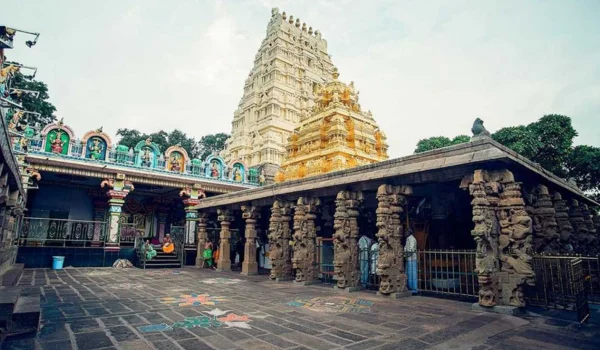
The Sri Bhramaramba Mallikarjuna Swamy Temple is the main attraction of Srisailam. Lord Mallikarjuna is worshipped as a Jyotirlinga, while Goddess Bhramaramba is worshipped as a major Shakti centre.
The temple complex contains historic gateways, halls, sculptures and shrines reflecting several periods of South Indian temple architecture.
- Srisailam Dam
The Srisailam Dam is built across the Krishna River and is one of the major multipurpose water projects of the region.
The reservoir and surrounding hills create a scenic landscape and make the dam one of the most recognisable landmarks around Srisailam.
- Pathala Ganga
Pathala Ganga is a sacred location on the Krishna River below the main temple area. Pilgrims traditionally visit the river as part of their Srisailam pilgrimage.
The surrounding hills and river landscape also make it an important sightseeing location.
- Akka Mahadevi Caves
The Akka Mahadevi Caves are natural limestone caves associated with religious traditions. They are located in the Nallamala landscape and are generally approached through the Krishna River region.
The caves combine natural scenery with spiritual significance.
- Shikaresvara Temple
The Shikaresvara Temple is located on one of the prominent hills around Srisailam. The location provides scenic views of the surrounding Nallamala landscape.
It is also an important religious stop for devotees visiting Srisailam.
- Sakshi Ganapati Temple
Sakshi Ganapati Temple is another well-known shrine near the main Srisailam temple. According to local religious tradition, devotees visit this shrine as part of their pilgrimage.
The temple is surrounded by the greenery of the Nallamala region.
- Nagarjunasagar-Srisailam Tiger Reserve
The forests surrounding Srisailam form part of the Nagarjunasagar-Srisailam Tiger Reserve landscape, one of the important protected forest areas of the Deccan.
The reserve supports diverse wildlife and forest ecosystems. Access to protected areas is subject to forest department rules and permitted tourism activities.
- Srisailam Ropeway
The ropeway provides a scenic way to experience the Krishna River and surrounding hills. It is particularly popular with visitors who want views of the valley and river landscape.
- Octopus View Point
The Octopus View Point is a scenic attraction in the Srisailam region. It provides views of the forested hills and the Krishna River landscape.
It is particularly attractive during periods when the surrounding vegetation is green.
- Phaladhara Panchadhara
Phaladhara Panchadhara is a religious and natural attraction associated with Srisailam. It is traditionally linked with Adi Shankaracharya and is visited by pilgrims interested in the spiritual history of the town.
Transport and Connectivity
Road Connectivity
Srisailam is connected by road with Nandyal, Kurnool, Markapur, Atmakur and Hyderabad.
The roads pass through the Nallamala Hills, making the journey scenic but also requiring careful driving because of winding hill sections and forest areas.
Railway Connectivity
Srisailam does not have a major railway station within the town.
Markapur Road is one of the important nearby railway stations used by visitors travelling to Srisailam. Other railway options are available around Nandyal and Kurnool, depending on the travel route.
Air Connectivity
Srisailam does not have a commercial airport.
Travellers generally use airports serving the wider region and continue by road. Kurnool Airport has been identified as an airport serving the Srisailam tourism route, while Hyderabad can also be an important option depending on flight availability and the traveller’s origin.
Best Time to Visit Srisailam
The best time to visit Srisailam is generally from October to February, when temperatures are more comfortable for temple visits, sightseeing and exploring the surrounding hills.
The monsoon season can make the Nallamala landscape particularly green and attractive, although heavy rainfall can affect road and forest travel.
Important experiences include:
- Mallikarjuna Temple pilgrimage
- Bhramaramba Temple visit
- Srisailam Dam
- Pathala Ganga
- Akka Mahadevi Caves
- Nallamala forest scenery
- Srisailam festivals
Maha Shivaratri is one of the most important festival periods and attracts very large numbers of devotees.
Nearby Cities, Districts and Areas
Important nearby cities, districts and regions include:
- Nandyal
- Kurnool
- Markapur
- Atmakur
- Dornala
- Nagarkurnool
- Hyderabad
- Kurnool region
- Nallamala Hills
- Krishna River valley
Srisailam’s location makes it an important connection point between the interior areas of Andhra Pradesh and Telangana. Its religious importance also brings visitors from many parts of southern and central India.
Why Is Srisailam Important?
Srisailam is important because it combines major Hindu pilgrimage traditions, historic temple architecture, forest ecosystems, river landscapes and major water infrastructure.
Its major strengths include:
- Mallikarjuna Jyotirlinga
- Bhramaramba Shakti tradition
- Ancient religious heritage
- Nallamala Hills
- Krishna River
- Srisailam Dam
- Nagarjunasagar-Srisailam forest landscape
- Akka Mahadevi Caves
- Rich Chenchu cultural heritage
- Strong pilgrimage tourism economy
Srisailam is therefore much more than a temple town. It is a major cultural and natural destination of Andhra Pradesh and an important part of the state’s religious tourism landscape.
FAQs About Srisailam
Is Srisailam a district?
No. Srisailam is currently a town and mandal in Nandyal district, Andhra Pradesh.
What is Srisailam famous for?
Srisailam is famous for the Mallikarjuna Jyotirlinga, Bhramaramba Temple, Srisailam Dam, Nallamala Hills, Krishna River and forest landscape.
Which district is Srisailam in?
Srisailam is in Nandyal district of Andhra Pradesh.
What is the PIN code of Srisailam?
The main PIN code of Srisailam is 518101.
Which river flows through Srisailam?
The Krishna River flows through the Srisailam region and forms the reservoir behind the Srisailam Dam.
What are the main tourist attractions in Srisailam?
Major attractions include Mallikarjuna Temple, Bhramaramba Temple, Srisailam Dam, Pathala Ganga, Akka Mahadevi Caves, Shikaresvara Temple and the Nallamala forests.
Why is Srisailam spiritually important?
Srisailam is especially important because Mallikarjuna is worshipped as one of the 12 Jyotirlingas and Bhramaramba is revered as a Shakti Peetha.
Conclusion
Srisailam is one of the most important pilgrimage destinations in Andhra Pradesh and a remarkable combination of spirituality, history and natural beauty. Although it is not a separate district today, its identity is strong enough to make it one of the best-known places in the state.
The Mallikarjuna-Bhramaramba temple complex, Srisailam Dam, Krishna River, Nallamala Hills, Akka Mahadevi Caves and surrounding forest landscape give the region exceptional religious and tourism importance. Its ancient traditions and continuing pilgrimage activity ensure that Srisailam remains an important cultural destination in southern India.