Ballia District is located in the eastern part of Uttar Pradesh and is one of the state’s historically important districts. The district headquarters is Ballia city, and the region is situated near the meeting area of the Ganga and Ghaghra rivers.
Ballia is known for its Bhojpuri culture, agricultural economy, religious heritage and important role in India’s freedom movement. The district is also popularly associated with the spirit of the Quit India Movement of 1942, because local people established a short-lived parallel administration during the freedom struggle.
Quick Information About Ballia District
| Particular | Details |
| District | Ballia |
| State | Uttar Pradesh |
| District Headquarters | Ballia |
| Formation as District | 1 November 1879 |
| Area | About 2,981 sq. km |
| Population | 32,39,774 (2011 Census) |
| Literacy Rate | 70.94% |
| Sex Ratio | 937 females per 1,000 males |
| Development Blocks | 17 |
| Tehsils | 6 |
| Main Languages | Hindi and Bhojpuri |
| Major Rivers | Ganga and Ghaghra (Saryu) |
| Famous For | Freedom movement, Bhojpuri culture, agriculture and religious heritage |
| Important Towns | Ballia, Rasra, Sikandarpur, Bansdih, Belthara Road, Bairia |
Ballia is predominantly rural and has a strong connection with agriculture and village-based economic activities. The district administration currently lists 6 tehsils, 17 development blocks and 2,361 villages.
Important PIN Codes in Ballia District
Some important PIN codes in Ballia District are:
| Area/Town | PIN Code |
| Ballia | 277001 |
| Bansdih | 277202 |
| Bairia | 277201 |
| Rasra | 221712 |
| Sikandarpur | 277303 |
| Belthara Road | 221715 |
| Maniyar | 277207 |
| Reoti | 277209 |
| Nagra | 221711 |
| Dubhar | 277204 |
| Chitbaragaon | 221713 |
| Sohaon | 277501 |
PIN codes can vary between individual villages and post offices, so the exact locality should be checked before sending important documents or parcels.
Important Facts About Ballia District
Here are some useful facts that make Ballia distinctive:
- Ballia city is the district headquarters.
- Ballia is located in eastern Uttar Pradesh.
- The district shares a boundary with Bihar.
- The Ganga and Ghaghra rivers are major geographical features.
- Ballia became a separate district during British rule in 1879.
- The district has a strong Bhojpuri cultural identity.
- Ballia played an important role in the Indian freedom movement.
- The district is popularly associated with the 1942 Quit India Movement.
- Mangal Pandey, an early figure associated with the 1857 uprising, is traditionally associated with the Ballia region.
- Agriculture is a major part of the district economy.
- Wheat, paddy, pulses and vegetables are among the important crops.
- Dadri Mela is one of the well-known traditional fairs of Ballia.
- The district has several religious and historical sites.
- Ballia lies close to the border of Bihar.
- The district has an important network of roads and railways connecting eastern Uttar Pradesh with Bihar.
Location and Geography
Ballia is situated in the extreme eastern part of Uttar Pradesh. It occupies a relatively narrow tract between important river systems and extends toward the Bihar border. The Ganga and Ghaghra influence the district’s landscape, agriculture and settlement pattern.
The district shares boundaries with:
- Mau District in the west
- Ghazipur District in the southwest
- Deoria District in the north
- Bihar toward the east and northeast
- Ganga River along parts of the southern boundary
- Ghaghra River along parts of the northern and eastern side
Important geographical features include:
- Ganga River
- Ghaghra River
- Riverine plains
- Fertile agricultural land
- Alluvial soils
- Flood-prone areas along major rivers
- Rural villages and agricultural fields
The river systems make the soil suitable for agriculture but can also create seasonal flooding in low-lying areas.
History of Ballia District
Ancient History
The history of Ballia goes back to ancient times. The district’s present territory was associated with the wider Kosala region and other ancient political and cultural centres of eastern India.
Archaeological findings from places such as Khaira Dih, Bhumapardih, Bijulipur and other sites indicate ancient settlements in the region. The district’s official history records evidence associated with the Black and Red Ware cultural tradition dating to the second millennium BCE.
Ballia’s history is also connected with traditional accounts involving sages such as Bhrigu, Valmiki, Vashishtha and Atri. These accounts form part of the region’s religious and cultural traditions.
Mauryan and Later Periods
The region came under the influence of major northern Indian empires, including the Mauryas. Archaeological remains also indicate Buddhist activity in parts of the area.
Later, the region was influenced by the Guptas, Maukharis, Harsha and other political powers. Its position near the Ganga and eastern Gangetic plains made it an important area for movement and settlement.
Medieval Period
During the medieval period, different parts of present-day Ballia came under the influence of the Jaunpur Sultanate, Bengal rulers, Delhi Sultanate and later Mughal administration.
Sikandarpur is traditionally associated with Sultan Sikandar Lodi, while several archaeological and historical remains show the long political history of the region.
British Period
Ballia became a tehsil of Ghazipur after the British established Ghazipur District in the late eighteenth century. On 1 November 1879, Ballia was established as a separate district.
Freedom Movement
Ballia has an important place in India’s freedom struggle.
The district actively participated in the Non-Cooperation Movement, Civil Disobedience Movement and Quit India Movement. Mahatma Gandhi visited Ballia in 1925, and nationalist activities continued strongly during the following decades.
In August 1942, during the Quit India Movement, Ballia witnessed a major uprising against British authority. Local leaders and residents briefly established a parallel administration under Chittu Pandey, who became popularly known as the “Sher-e-Ballia.”
This episode is one of the main reasons Ballia is popularly called “Baghi Ballia”, or rebellious Ballia.
Population of Ballia District
According to the 2011 Census, Ballia District had a population of 32,39,774. The district had 16,72,902 males and 15,66,872 females, giving a sex ratio of 937 females per 1,000 males.
The district’s 2011 literacy rate was 70.94%. About 29.36 lakh people lived in rural areas, while approximately 3.04 lakh lived in urban areas.
The population is predominantly Hindi-speaking, while Bhojpuri has a strong cultural and linguistic presence.
Economy of Ballia District
The economy of Ballia is primarily based on agriculture, trade, small businesses, services and transport.
Important economic activities include:
- Agriculture
- Food processing
- Agricultural trading
- Retail markets
- Transport
- Small-scale industries
- Dairy and livestock
- Handicrafts
- Government services
- Local businesses
The fertile river plains support extensive agricultural activity.
Agriculture in Ballia
Agriculture is one of the most important economic activities in Ballia. The alluvial soils deposited by the Ganga and Ghaghra river systems support crop cultivation.
Major crops include:
- Paddy
- Wheat
- Maize
- Pulses
- Oilseeds
- Vegetables
- Sugarcane in suitable areas
- Seasonal fruits
Farmers also depend on irrigation from canals, tube wells and other local sources.
Because of its riverine geography, agriculture remains important but some areas are vulnerable to seasonal flooding.
Handloom and Traditional Industries
Ballia has a strong tradition of rural crafts and household-based economic activities.
Traditional products may include:
- Handwoven textiles
- Bamboo products
- Cane articles
- Earthen products
- Traditional household items
- Local handicrafts
The district’s Bhojpuri cultural traditions are also reflected in folk songs, theatre, festivals, fairs and traditional clothing.
Industries and Business in Ballia
Ballia is not among the major heavy-industrial districts of Uttar Pradesh. Its business environment is mainly based on agriculture, trade, transport, services and small industries.
Important business sectors include:
- Agro-processing
- Grain trading
- Food businesses
- Retail
- Construction
- Transport
- Dairy
- Small manufacturing
- Wholesale markets
- Tourism and hospitality
Ballia, Rasra, Sikandarpur, Bansdih and Belthara Road are important commercial centres serving surrounding rural areas.
Education in Ballia
Ballia has a network of government and private schools, colleges and higher educational institutions.
An important higher education institution is Jananayak Chandrashekhar University, located in Ballia. The university contributes to higher education and academic development in the district.
The district also has colleges providing undergraduate and postgraduate education in subjects such as arts, science, commerce and other disciplines.
Education has played an important role in Ballia’s social development, particularly because the district has a large rural population.
District Court in Ballia
The District Court, Ballia is located in the district headquarters area and provides judicial services for residents of the district.
The district judiciary deals with civil, criminal and other legal matters according to the applicable judicial framework. Courts and subordinate judicial institutions serve people from Ballia and its surrounding tehsils.
For a specific court matter, visitors should confirm the current court building, working hours and case-related requirements before travelling.
District Hospital and Healthcare
Ballia has government healthcare facilities serving both urban and rural populations.
The district healthcare network includes:
- District-level hospital services
- Community Health Centres
- Primary Health Centres
- Sub-centres
- Maternal and child healthcare
- Immunisation services
- Emergency care
- Rural health services
- Referral facilities
The district administration’s public-utility information identifies one district-level hospital facility along with other healthcare services operating through the broader health network.
Popular Tourist Attractions in Ballia
Ballia offers a combination of religious places, river landscapes, historical locations, fairs and freedom-movement heritage.
- Bhrigu Temple
The Bhrigu Temple in Ballia is associated with the ancient sage Bhrigu. It is an important religious site and is connected with the traditional identity of the district.
The temple and surrounding area become particularly active during religious occasions and local fairs.
- Dadri Mela
Dadri Mela is one of the best-known traditional fairs of Ballia. It is associated with the cultural and religious life of the district and attracts visitors from nearby areas.
The fair features religious activities, local trade and traditional entertainment.
- Bhrigu Ashram
Bhrigu Ashram is associated with the traditions surrounding Sage Bhrigu. It is an important religious and cultural landmark for local residents.
The site reflects Ballia’s long-standing connection with ancient Hindu traditions.
- Suraha Tal
Suraha Tal is a notable wetland and lake area near Ballia. It has ecological importance and is associated with migratory birds during suitable seasons.
It is a useful destination for visitors interested in nature and birdwatching.
- Chittu Pandey Memorial and Freedom Movement Sites
Ballia has several places associated with its freedom movement history. The legacy of Chittu Pandey and the 1942 uprising remains an important part of local heritage.
Visitors interested in modern Indian history can explore places and institutions connected with the district’s nationalist movement.
- Mangal Pandey Memorial Area
The district is associated with Mangal Pandey, one of the prominent figures linked with the 1857 uprising. His birthplace and memorial-related heritage are important parts of Ballia’s historical identity.
The site attracts visitors interested in the history of India’s struggle against British rule.
- Ballia Ghat and Ganga River Area
The Ganga riverfront around Ballia provides a scenic environment for visitors. River ghats are also associated with religious activities and local festivals.
The landscape is particularly attractive during the cooler months.
- Khaira Dih
Khaira Dih is an important archaeological site near Rasra. Excavations have produced evidence of ancient settlement and material culture.
The site is valuable for understanding the long history of the eastern Gangetic region.
- Rasra
Rasra is one of Ballia’s important towns and commercial centres. It also has historical and cultural significance and serves as a base for exploring surrounding rural areas.
- Sikandarpur
Sikandarpur is a historic town traditionally associated with the period of Sikandar Lodi. Its historical background and local markets make it an interesting part of a Ballia district tour.
Transport and Connectivity
Road Connectivity
Ballia is connected by road with important cities and districts of eastern Uttar Pradesh and Bihar.
Major road connections lead toward:
- Ghazipur
- Mau
- Deoria
- Varanasi
- Chhapra
- Bihar border areas
Road transport is particularly important for connecting the district headquarters with rural blocks and villages.
Railway Connectivity
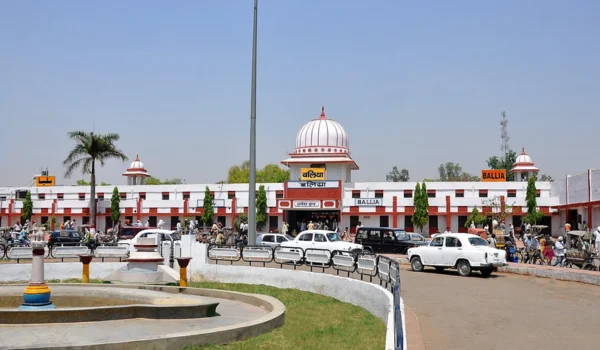
Ballia has an important railway network. Ballia railway station serves the district headquarters, while stations such as Rasra and Belthara Road provide additional rail connectivity.
Rail services connect the district with cities in Uttar Pradesh, Bihar and other parts of northern India.
Air Connectivity
Ballia does not have a major commercial airport. Travellers generally use airports at Varanasi and other larger nearby cities and continue the journey by road or rail.
Best Time to Visit Ballia
The most comfortable period for visiting Ballia is generally October to February, when temperatures are more suitable for sightseeing and outdoor activities.
Visitors can consider:
- Visiting religious sites
- Exploring freedom movement heritage
- Attending local fairs
- Visiting Suraha Tal
- Exploring Ganga river areas
- Exploring historical sites
- Experiencing Bhojpuri culture and local markets
Summer can become very hot, while the monsoon may bring river flooding in some low-lying areas.
Nearby Cities, Districts and Areas
Important nearby cities, districts and regions include:
- Ghazipur
- Mau
- Deoria
- Varanasi
- Chhapra, Bihar
- Siwan, Bihar
- Buxar, Bihar
- Ganga river belt
- Ghaghra river belt
- Bihar border areas
Ballia’s location near Bihar and along important rivers gives it considerable cultural and economic importance in eastern Uttar Pradesh.
Why Is Ballia District Important?
Ballia is important because of its historical contribution to India’s freedom struggle, fertile agricultural plains, Bhojpuri culture and strategic location in eastern Uttar Pradesh.
Its major strengths include:
- Strong freedom movement heritage
- Association with the 1942 Quit India Movement
- Bhojpuri cultural identity
- Ganga and Ghaghra river systems
- Fertile agricultural land
- Important religious sites
- Historical and archaeological remains
- Rail and road connectivity
- Regional trade
- Strong rural economy
Ballia’s identity as “Baghi Ballia” remains closely connected with the district’s role in India’s national movement.
FAQs About Ballia District
What is Ballia District famous for?
Ballia is famous for its freedom movement history, Bhojpuri culture, religious heritage, agriculture and association with the 1942 Quit India Movement.
What is the headquarters of Ballia District?
The district headquarters is Ballia city.
What is the population of Ballia District?
According to the 2011 Census, Ballia had a population of 32,39,774.
When was Ballia District formed?
Ballia was established as a separate district on 1 November 1879 during British rule.
Which rivers are important in Ballia?
The Ganga and Ghaghra are the two major rivers associated with the district.
What is Ballia called because of its freedom struggle?
Ballia is popularly known as “Baghi Ballia”, reflecting its strong participation in the freedom movement, particularly during the Quit India Movement of 1942.
Which languages are commonly spoken in Ballia?
Hindi and Bhojpuri are widely spoken in the district.
Conclusion
Ballia District is one of the historically significant districts of eastern Uttar Pradesh. Its identity is shaped by the Ganga and Ghaghra rivers, fertile agricultural land, Bhojpuri culture, religious traditions and a remarkable role in India’s freedom struggle.
From the heritage of Bhrigu and ancient archaeological sites to the nationalist activities associated with Mangal Pandey and Chittu Pandey, Ballia has a long and diverse history. Its combination of agriculture, culture, historical sites and regional connectivity continues to make it an important district of Uttar Pradesh.