Vijayanagara District is one of the historically important districts of Karnataka, located in the central-northern part of the state. The district headquarters is Hosapete, and the district is internationally famous for Hampi, the magnificent former capital of the Vijayanagara Empire.
The district combines a remarkable historical heritage with agriculture, tourism, industries and natural landscapes. The Tungabhadra River, Hampi monuments, ancient temples, Tungabhadra Dam, agricultural areas and traditional settlements are important features of the district. Vijayanagara District was created as a separate district in 2021 after being carved out of Ballari District.
Quick Information About Vijayanagara District
| Particular | Details |
| District | Vijayanagara |
| State | Karnataka |
| District Headquarters | Hosapete |
| Formation | 2021 |
| Area | 5,644 sq. km |
| Population | 13,53,628 |
| Revenue Sub-Divisions | 2 |
| Revenue Taluks | 6 |
| Main Language | Kannada |
| Other Languages | Telugu, Urdu and others |
| Major River | Tungabhadra |
| Famous For | Hampi, Vijayanagara Empire, temples, heritage monuments and Tungabhadra Dam |
| Important Towns | Hosapete, Harapanahalli, Kudligi, Huvina Hadagali, Hagari Bommanahalli and Kottur |
According to the district administration’s demographic information, Vijayanagara covers 5,644 sq. km and had a population of 13,53,628 based on the 2011 Census figures used for the present district. The district has two revenue sub-divisions and six taluks.
Important PIN Codes in Vijayanagara District
PIN codes vary according to individual towns and post offices. Some important PIN codes include:
| Area/Town | PIN Code |
| Hosapete | 583201 |
| Hampi | 583239 |
| Harapanahalli | 583131 |
| Kudligi | 583135 |
| Huvina Hadagali | 583219 |
| Hagari Bommanahalli | 583212 |
| Kottur | 583134 |
| Kamalapur | 583221 |
| Mariyammanahalli | 583222 |
| Kampli | 583132 |
| Tungabhadra Dam | 583225 |
| Hospet Industrial Area | 583203 |
PIN codes may differ between nearby villages and individual post offices. The exact PIN should be verified according to the particular postal address before being used for official purposes.
Important Facts About Vijayanagara District
Here are some useful facts that make Vijayanagara distinctive:
- Vijayanagara is one of the newer districts of Karnataka.
- The district was created from the former Ballari District.
- Hosapete is the district headquarters.
- The district was established as a separate administrative district in 2021.
- It has 2 revenue sub-divisions.
- It has 6 taluks.
- The district covers about 5,644 sq. km.
- The 2011 Census-based population used by the district administration is 13,53,628.
- Hampi is the district’s most famous heritage destination.
- Hampi was the capital of the powerful Vijayanagara Empire.
- The Tungabhadra River is one of the most important geographical features.
- Tungabhadra Dam is an important irrigation and tourism landmark.
- Agriculture is supported by the Tungabhadra irrigation system.
- Major crops include paddy, cotton, sunflower, maize and groundnut.
- The district has mineral resources and industrial activity.
- Ancient Chalukyan and Vijayanagara-period temples can be found in several parts of the district.
- The district has considerable potential for heritage, religious, cultural and nature tourism.
Location and Geography
Vijayanagara District is situated in the northern part of Karnataka and forms part of the historical Deccan region. The landscape contains rocky hills, plains, agricultural fields, river valleys and historic settlements.
The district shares boundaries with:
- Ballari District towards the east and southeast
- Koppal District towards the north
- Gadag District towards the northwest
- Haveri District towards the west
- Davanagere District towards the southwest
- Chitradurga District towards the south
Important geographical features include:
- Tungabhadra River
- Tungabhadra reservoir
- Rocky granite hills around Hampi
- Dry and semi-arid landscapes
- Agricultural plains
- Irrigated farming areas
- Historic hill settlements
- Forest and scrub landscapes
The Tungabhadra River is especially important for agriculture, settlement and tourism. The rocky terrain around Hampi also gives the district a distinctive natural appearance.
History of Vijayanagara District
Ancient and Medieval Background
The area now forming Vijayanagara District has a long history. Several dynasties ruled different parts of the region before the emergence of the Vijayanagara Empire.
The region contains temples and monuments associated with the Chalukyas, Hoysalas and other Deccan powers. Places such as Kuruvatti, Ujjini and other historic settlements preserve examples of medieval South Indian architecture.
Vijayanagara Empire
The district takes its name from the Vijayanagara Empire, one of the most powerful kingdoms in South Indian history.
The empire was founded in 1336 by Harihara and Bukka. Its capital developed at Vijayanagara, the city whose ruins are now centred around Hampi.
The empire reached great political, economic and cultural importance under rulers such as Krishnadevaraya. Hampi became a major centre of administration, trade, religion, art and architecture.
Foreign travellers who visited the city described its impressive markets, temples, fortifications and wealth.
Hampi and the Battle of 1565
The Battle of Talikota in 1565 was a major turning point. Following the defeat of the Vijayanagara forces, the capital was attacked and much of the city was destroyed.
Hampi was gradually abandoned, but its temples, gateways, bazaars, royal buildings and monuments survived as an extraordinary archaeological landscape.
Today, Hampi is recognised as a UNESCO World Heritage Site and is one of India’s most important heritage destinations.
Modern District Formation
For many years, the area was part of Ballari District. The Government of Karnataka created Vijayanagara District as a separate administrative unit to improve governance and recognise the area’s distinct historical, geographical and economic identity.
Hosapete was selected as the district headquarters.
Population of Vijayanagara District
The district administration’s demographic profile records a 2011 Census-based population of 13,53,628 for the present district.
The population is distributed between urban centres, towns and a large rural area. Major population and commercial centres include Hosapete, Harapanahalli, Kudligi, Huvina Hadagali, Hagari Bommanahalli and Kottur.
Kannada is the principal language of administration and everyday communication, while Telugu, Urdu and other languages are also spoken in different communities.
Economy of Vijayanagara District
The economy of Vijayanagara is based on a combination of agriculture, tourism, industry, mining-related activities, trade and services.
Major economic sectors include:
- Agriculture
- Irrigated farming
- Tourism
- Hospitality
- Mining and mineral-related activities
- Manufacturing
- Food processing
- Trade
- Transport
- Construction
- Small and medium enterprises
Tourism is particularly important around Hampi and Hosapete, creating employment in hotels, restaurants, transport, handicrafts, guiding and other visitor-related services.
Agriculture in Vijayanagara District
Agriculture remains a major source of livelihood. The Tungabhadra irrigation system has played an important role in supporting agriculture in the district.
Major crops include:
- Paddy
- Cotton
- Sunflower
- Maize
- Groundnut
- Pulses
- Vegetables
- Fruits
Irrigated areas near the Tungabhadra system have better agricultural potential, while farming in drier parts depends more heavily on rainfall and groundwater.
Agriculture also supports local trade, food processing, transportation and rural employment.
Handloom and Traditional Industries
Vijayanagara is better known for its heritage, agriculture and traditional crafts than for a single large handloom industry.
Traditional activities include:
- Textile-related work
- Handicrafts
- Stone-related crafts
- Metal and wood work
- Local artisan production
- Traditional religious items
The tourism economy around Hampi also creates demand for locally produced handicrafts and traditional souvenirs.
Industries and Business in Vijayanagara District
The district has a developing industrial economy supported by its mineral resources, agricultural production and transportation network.
Important business sectors include:
- Mineral-based industries
- Manufacturing
- Food processing
- Rice and grain processing
- Cotton-related activities
- Engineering
- Construction materials
- Tourism and hospitality
- Transport and logistics
- Retail trade
- Small and medium enterprises
Hosapete is the main commercial and industrial centre. Other towns such as Harapanahalli, Kudligi and Hagari Bommanahalli also support regional trade and small industries.
The district’s proximity to major parts of northern Karnataka and its road and railway connectivity support movement of agricultural and industrial products.
Education in Vijayanagara District
Education is an important part of the district’s social infrastructure. Schools, pre-university colleges, degree colleges, technical institutions and professional educational facilities are available in the major towns.
Hosapete is an important educational centre, while Harapanahalli, Kudligi, Huvina Hadagali and other taluk headquarters provide educational facilities for surrounding rural areas.
The district’s heritage sites also have educational importance because Hampi attracts students, researchers, historians, archaeologists and architecture enthusiasts from India and abroad.
District Court in Vijayanagara
The district has judicial infrastructure serving its population, with the district-level judicial system centred around the district headquarters and subordinate courts serving different territorial jurisdictions.
Court services are important for the district’s urban and rural population. Visitors should verify the current court complex, jurisdiction and working arrangements before attending a legal proceeding.
District Hospital and Healthcare
Healthcare services are provided through government hospitals, community-level facilities and private medical institutions.
Important healthcare categories include:
- District-level hospital services
- Taluk hospitals
- Community Health Centres
- Primary Health Centres
- Sub-centres
- Private hospitals
- Clinics
- Diagnostic centres
- Pharmacies
Hosapete is the main healthcare centre for the district, while taluk headquarters provide healthcare services to surrounding rural communities.
Popular Tourist Attractions in Vijayanagara District
Vijayanagara is one of Karnataka’s most important tourism districts. Its greatest attraction is the historic Hampi archaeological landscape, but several temples, wildlife areas and natural destinations are also worth visiting.
- Hampi
Hampi is the most famous attraction of Vijayanagara District and the former capital of the Vijayanagara Empire.
The ruins spread across a vast rocky landscape and include temples, royal complexes, markets, gateways and water structures. Hampi is a UNESCO World Heritage Site and attracts visitors from around the world.
- Virupaksha Temple
The Virupaksha Temple is one of the most important living temples at Hampi. Dedicated to Lord Shiva in the form of Virupaksha, the temple has a long history that predates the height of the Vijayanagara Empire.
Its large gateway, temple architecture and religious traditions make it one of Hampi’s essential attractions.
- Vijaya Vittala Temple and Stone Chariot
The Vijaya Vittala Temple is among the finest examples of Vijayanagara architecture.
Its famous Stone Chariot has become one of the most recognisable monuments of Hampi. The temple complex also contains richly carved pillars and other architectural features.
- Ugra Narasimha
The Ugra Narasimha, also known as Lakshmi Narasimha, is a massive monolithic sculpture at Hampi.
The sculpture depicts Lord Narasimha, an incarnation of Lord Vishnu, and is one of the most impressive stone monuments in the Hampi area.
- Lotus Mahal
Lotus Mahal is an elegant two-storey structure within the royal enclosure of Hampi.
Its distinctive architectural design combines elements associated with Indian and Islamic architectural traditions and makes it one of the most photographed structures in the heritage area.
- Mahanavami Dibba
The Mahanavami Dibba is a large stone platform associated with royal ceremonies during the Vijayanagara period.
Its carvings provide valuable information about the courtly life, festivals and ceremonial traditions of the empire.
- Tungabhadra Dam
The Tungabhadra Dam near Hosapete is both an important irrigation project and a popular local attraction.
The reservoir creates a large water landscape surrounded by hills. The area is particularly attractive during and after the monsoon season when the surroundings become greener.
- Ankasamudra Bird Sanctuary
Ankasamudra Bird Sanctuary is located in the Hagaribommanahalli area.
It is known for its wetland environment and birdlife, providing opportunities for nature lovers and bird-watchers.
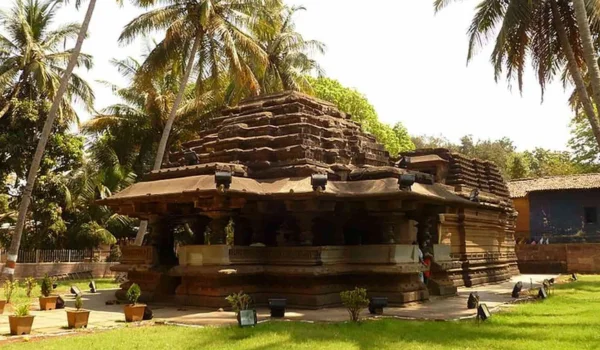
- Mallikarjuna Temple, Kuruvatti
The Mallikarjuna Temple at Kuruvatti is an important medieval temple associated with the Kalyana Chalukya period.
The temple, dating to around the 11th century, is significant for its architecture and historical value.
- Mylara Lingeshwara Temple
The Mylara Lingeshwara Temple at Mylara is a well-known religious site on the bank of the Tungabhadra River.
The annual festival attracts large numbers of devotees and is an important part of the local cultural calendar.
Transport and Connectivity
Road Connectivity
Vijayanagara has road connections with Ballari, Koppal, Gadag, Davanagere, Chitradurga and other parts of Karnataka.
Hosapete is an important road junction and serves as the main gateway to Hampi. Roads also connect the district’s taluk headquarters and rural areas.
Railway Connectivity
Hosapete Junction is an important railway station for the district. It provides rail connections towards Ballari, Hubballi, Bengaluru and other parts of Karnataka and neighbouring states.
Rail connectivity is particularly useful for visitors travelling to Hampi.
Air Connectivity
The nearest major commercial airports include Jindal Vijayanagar Airport near Toranagallu and Hubballi Airport, depending on the travel route and destination.
For international and wider domestic connections, travellers can also use major airports in Karnataka and neighbouring regions.
Best Time to Visit Vijayanagara District
The best time to visit Vijayanagara is generally October to February, when temperatures are more comfortable for exploring Hampi and other outdoor attractions.
The cooler months are particularly suitable for:
- Hampi sightseeing
- Virupaksha Temple
- Vijaya Vittala Temple
- Stone Chariot
- Royal Enclosure
- Tungabhadra Dam
- Ankasamudra Bird Sanctuary
- Historic temples in the district
The monsoon season can make the landscape greener, especially around the Tungabhadra reservoir, but visitors should consider rainfall when planning outdoor sightseeing.
Nearby Cities, Districts and Areas
Important nearby places include:
- Ballari
- Koppal
- Gadag
- Davanagere
- Chitradurga
- Hubballi
- Hospet/Hosapete
- Hampi
- Harapanahalli
- Kudligi
- Huvina Hadagali
- Hagari Bommanahalli
- Kottur
The district’s location makes it an important link between northern and central Karnataka. Hampi also gives the district international visibility and a major role in Karnataka’s heritage tourism economy.
Why Is Vijayanagara District Important?
Vijayanagara District is important because it combines world-famous heritage, agriculture, tourism, industry and cultural traditions.
Its major strengths include:
- Hampi UNESCO World Heritage Site
- Legacy of the Vijayanagara Empire
- Rich temple architecture
- Tungabhadra River
- Tungabhadra irrigation system
- Important agricultural production
- Tourism and hospitality
- Mineral and industrial resources
- Strong road and railway connectivity
- Diverse cultural and religious heritage
The district preserves one of India’s most significant medieval urban and architectural landscapes while also supporting a modern economy based on agriculture, tourism and industry.
FAQs About Vijayanagara District
Where is Vijayanagara District located?
Vijayanagara District is located in the northern part of Karnataka and forms part of the historical Deccan region.
When was Vijayanagara District formed?
Vijayanagara became a separate district in 2021, after being carved out of the former Ballari District.
What is the headquarters of Vijayanagara District?
The district headquarters is Hosapete.
How many taluks are there in Vijayanagara District?
The district currently has 6 taluks: Hosapete, Harapanahalli, Kudligi, Huvina Hadagali, Hagari Bommanahalli and Kottur.
What is Vijayanagara District famous for?
The district is most famous for Hampi and the heritage of the Vijayanagara Empire. It is also known for the Tungabhadra River, temples, agriculture, Tungabhadra Dam and cultural heritage.
What is the main tourist attraction in Vijayanagara District?
Hampi is the district’s most important tourist attraction. Other major destinations include Virupaksha Temple, Vijaya Vittala Temple, Stone Chariot, Lotus Mahal, Mahanavami Dibba and Tungabhadra Dam.
Which river is important in Vijayanagara District?
The Tungabhadra River is the most important river in the district. It supports agriculture and is closely associated with the history and landscape of Hampi.
Conclusion
Vijayanagara District is a remarkable part of Karnataka where India’s medieval history, cultural heritage and modern economic development come together. The district is globally recognised because of Hampi, the magnificent capital of the Vijayanagara Empire, while Hosapete serves as its modern administrative and commercial centre.
Beyond Hampi, the district has fertile agricultural areas supported by the Tungabhadra irrigation system, important temples, wildlife destinations, industrial activities and natural landscapes. Its historical importance, tourism potential, agricultural economy and strategic location make Vijayanagara one of Karnataka’s most distinctive districts.